Quick Answer: Deck repair cost in Sacramento usually tracks national bands: HomeAdvisor puts typical repairs between $800 and $3,500, and Angi reports an average near $2,245 for board, stair, and railing work. Ledger rot, second-story access, and composite matching push local bids higher. City vs county permits matter on rebuilds. Vertex is licensed CA #1135543.
Table of Contents
Deck repair sacramento searches spike when a board flexes underfoot, a railing shifts, or soft wood shows at the ledger where the deck meets the house. Cost is the second question. The first should be whether the frame and footings still deserve repair money at all.
This guide uses published national ranges from Angi and HomeAdvisor, then explains what moves Sacramento bids inside or above those bands: access, ledger condition, material match, and city versus county permits. It is not a twin of our dry-rot siding guide and not a substitute for a walk-through on deck repair and building in Sacramento. Vertex Maintenance & Remodeling is licensed CA #1135543 (B + C13).
How Much Does Deck Repair Cost in Sacramento?
We do not invent a Sacramento-only average. Published national data is the honest starting point:
- HomeAdvisor lists typical deck repairs between $800 and $3,500 when boards, railings, or mold issues are the scope.
- Angi’s 2026 deck repair and replacement guide puts the average repair near $2,245 for work like fixing boards, loose steps, and wobbly railings.
- Angi also notes materials can run roughly $3 to $45 per square foot depending on the deck type you are matching.
Local bids in Sacramento, West Sacramento, Roseville, Folsom, and Elk Grove often land inside that national repair band for board and railing work on a ground-level deck with easy side-yard access. They move up when scaffolding is required, when the ledger is soft, when composite stock must be matched, or when a permit set is required for a partial rebuild.
| Scope (national published ranges) | Cited range | Source |
|---|---|---|
| Typical deck repair project | $800-$3,500 | HomeAdvisor |
| Average deck repair | About $2,245 | Angi 2026 |
| Board replacement (project band) | $500-$4,000 | Angi 2026 |
| Railing repairs | $500-$4,000 | Angi 2026 |
| Resurfacing | $15-$50 per sq ft | Angi 2026 |
| Railing replacement | $35-$210 per linear foot | Angi / HomeAdvisor railing bands |
Treat the table as a planning frame, not a quote. Your written scope after a probe of boards, railings, stairs, posts, and the ledger is the number that matters.
What Drives Deck Repair Prices Up or Down Here?
Access is first. A ground-level deck open from the yard is a different job from a second-story surface over a narrow side yard in Land Park or Curtis Park (95818). Scaffolding and material staging add labor even when the board count looks small.
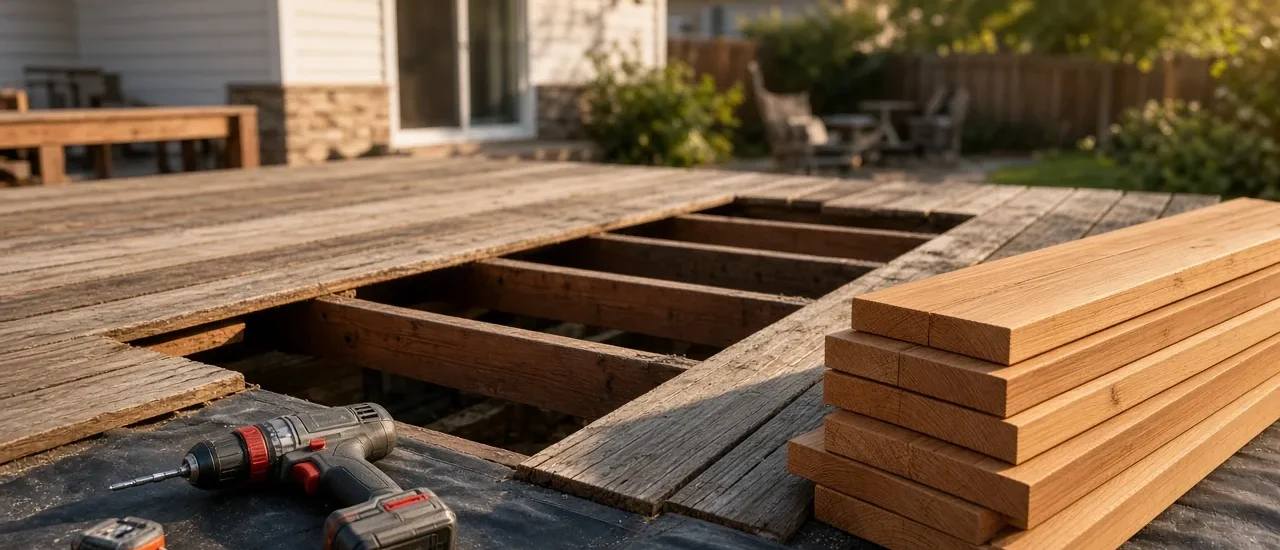
Depth of damage is second. Surface boards and balusters stay in the national repair band. Soft joists, failed flashing, or a soft ledger move the job toward structural repair and often a permit. That is the jump homeowners miss when they only photograph the top boards.
Material match is third. Pressure-treated replacement boards are easier to source than a discontinued composite color from a ten-year-old install. Matching redwood or cedar grain and remaining stock on mid-century Sacramento decks takes more shop time.
Moisture source is fourth. If irrigation hits the ledger line, or flashing failed years ago, replacing boards without fixing the water path buys a second repair. We price the source fix with the board work so you are not paying twice.
How Much Do Board and Railing Repairs Usually Run?
Angi’s 2026 figures put board replacement projects in a $500 to $4,000 band and railing repairs in the same $500 to $4,000 band depending on how much of the system fails. Full railing replacement is often priced per linear foot – Angi and HomeAdvisor both cite roughly $35 to $210 per linear foot depending on wood, composite, cable, or metal systems.
Resurfacing – new walking surface and often railings while keeping a sound frame – sits higher on a per-square-foot basis. Angi lists about $15 to $50 per square foot for resurfacing. That option only makes sense when joists, posts, and the ledger probe solid. If the frame is soft, resurfacing is a cosmetic cover on a structural problem.
Stairs get their own line. Loose treads and weak stringers are a fall risk. National guides break stair work out separately from field boards; on our walk-throughs we price stairs as their own safety item so they do not get buried in a board count.
On Sacramento estimates we also separate optional upgrades – hidden fasteners, matching fascia, stair lighting – from must-fix safety items. Optional lines should never be required to make a repair look complete on paper. If a bid buries safety work inside an upgrade package, ask for the split in writing.
Composite and Trex repairs price differently from wood because board lengths, hidden clip systems, and color batches limit partial swaps. Sometimes replacing a full bay costs less frustration than hunting a discontinued SKU for three boards. We say that on the walk-through when stock is the real constraint.
When Does Repair Cost More Than a Rebuild?
Repair costs stack when you open bay after bay and keep finding soft wood. At some point the labor to cut, sister, flash, and match exceeds the labor to rebuild on new footings with a clean plan set. There is no magic percentage that fits every deck. The honest signal is how far the screwdriver sinks at the ledger and along primary joists.
Rebuild also wins when guards and stairs no longer meet current code and the existing layout cannot accept a safe retrofit without fighting the old frame. A targeted repair still wins when damage is local, footings are sound, and you want to keep a wood deck that still has years left after cutouts.
We write repair-versus-rebuild in plain language before demo. If opening the ledger changes the read, we stop and reset the scope with you instead of discovering it on the final invoice.
Why Do Sacramento Decks Fail Even With Mild Winters?
Sacramento summers cook unfinished wood and fade cheap composite on west and south exposures. Winter rain arrives in a concentrated stretch and finds end grain, open screw holes, and failed flashing. That swell-shrink cycle opens coatings and joints year after year.
Irrigation and grade against posts keep wood wet when the sky is clear. Homes in 95818, 95825, 95834, Folsom 95630, Roseville 95678, and Elk Grove 95758 show the same pattern: sun damage on top, moisture trouble at the ledger and posts.
Ledger failure is the collapse risk. Soft wood at the house connection is not a stain problem. Cut it out to solid framing and correct flashing – do not paint over it.
Do You Need a Permit for Deck Repair in Sacramento?
Like-for-like board swaps on an existing legal deck often stay outside a full building permit, but that is not a blanket rule. Attached decks, taller walking surfaces, stair and guard changes, electrical, and any work that changes structure usually need review.
Inside Sacramento city limits, permits run through City of Sacramento Community Development (Public Permit Portal / Electronic Plan Check for plan-review jobs). Unincorporated parcels use Sacramento County Building Permits and Inspection through Accela. Roseville, Folsom, Elk Grove, and West Sacramento each have their own building departments.
Small detached low decks sometimes qualify for exemptions. We confirm jurisdiction from your address before we draw a plan set or promise a no-permit path. Guessing wrong is how closeout stalls.
How Is Deck Repair Different From Dry Rot on Siding?
Deck repair is about a walking surface, guards, stairs, posts, and the ledger connection. Dry rot on siding and trim is about the weather shell of the house. Both involve soft wood and moisture, but the cost tables and permit triggers are not the same.
If your main problem is soft window trim, fascia, or siding courses – not the deck frame – use our dry rot repair cost guide for those Angi-cited exterior ranges. If the screwdriver sinks at the ledger or joists, stay on this deck path and get a structural read before you budget boards alone.
What Should You Ask Before You Sign a Deck Repair Bid?
- Did they probe the ledger, joists, posts, stairs, and railings with you present?
- Is repair-versus-rebuild written as a clear choice, not a vague allowance?
- Which permit desk owns your address – city or county – and who pulls the permit?
- What happens if opening a bay reveals more rot than the probe showed?
- Can you verify their license on the CSLB site? Ours is CA #1135543.
A low board-only number that never mentions the ledger is not a bargain. It is a second visit waiting for the next rain.
Bottom Line: Who Should Repair and Who Should Rebuild
Repair makes sense when the frame and footings are sound, damage is local, and national-range board or railing work will restore safe use. Rebuild makes sense when the ledger is soft, joists fail the probe across multiple bays, or code-required guards and stairs cannot be retrofitted cleanly.
Use Angi and HomeAdvisor bands to set expectations, then get a Sacramento walk-through that names your jurisdiction and your ledger condition. Call or text (916) 389-1796, or request a free estimate from Vertex Maintenance & Remodeling.
Sources: Angi, “How Much Does Deck Replacement or Repair Cost? [2026 Data]”; HomeAdvisor, “How Much Does It Cost to Build a Deck” (deck repair section, typical $800-$3,500); City of Sacramento Community Development building permit guidance; Sacramento County Building Permits and Inspection; California Contractors State License Board Check a License; Vertex field practice in Sacramento metro (2024-2026).