A damaged commercial floor does not automatically need to be replaced.
A cracked section of concrete, several loose VCT tiles, damaged LVP, or a worn section of epoxy may be repairable without tearing out the rest of the floor. When the damage starts spreading, keeps coming back, or involves the slab or subfloor underneath, replacement can make more financial sense.
For property managers and business owners, the decision usually comes down to three things: what the repair costs now, how long it is likely to last, and how much disruption the work creates.
Here is how to look at those numbers before approving the project.
How much does commercial floor repair cost?
There is no useful flat price for commercial floor repair because a 50-square-foot epoxy patch and a damaged 5,000-square-foot warehouse slab are completely different jobs.
For planning purposes, current commercial flooring costs generally fall into ranges like these:
| Flooring system | Typical installed planning range |
|---|---|
| Sealed concrete | $2–$6 per sq. ft. |
| Polished concrete | $4–$16 per sq. ft. |
| Standard commercial epoxy | $3–$12 per sq. ft. |
| Heavy-duty industrial epoxy | $8–$25+ per sq. ft. |
| Commercial LVT | $5–$12 per sq. ft. |
| Commercial carpet tile | $3.50–$7.50 per sq. ft. |
| Ceramic or porcelain tile | $7–$25 per sq. ft. |
Those numbers are mainly useful for understanding the cost of restoring or replacing larger areas. Small repairs are often priced differently because mobilization, demolition, grinding, prep, matching material, equipment, and cleanup still have to happen even when the damaged area is small.
That is why a 100-square-foot repair will not necessarily cost one-tenth of a 1,000-square-foot project.
If you already know the type of damage you’re dealing with, Vertex Maintenance provides commercial floor repair and replacement for concrete, epoxy, tile, VCT, vinyl, LVP, warehouse floors, and other commercial flooring systems.
Why Sacramento and Bay Area flooring costs can be different
Material prices are only part of a commercial flooring quote.
Labor, access, scheduling, parking, site restrictions, demolition, floor preparation, and the amount of time crews need to spend inside an operating building all matter.
Labor costs also vary considerably across Northern California.
Federal labor data shows average wages across all occupations in the San Francisco-Oakland-Fremont metro are substantially higher than in the Sacramento-Roseville-Folsom area.
That does not mean you should automatically add a fixed percentage to a Sacramento flooring estimate.
It does mean a labor-heavy repair in San Francisco, Oakland, or another Bay Area market can reasonably cost more than similar work in the Sacramento area, especially when the project involves difficult access, paid parking, loading restrictions, nights, weekends, or multiple mobilizations.
For budgeting, use published square-foot ranges as a starting point, not as a quote.
The actual condition of the floor matters more.
What actually drives commercial floor repair cost?
The visible damage is only the first part of the estimate.
How much of the floor is damaged?
A few cracked tiles or a localized section of damaged coating usually favors repair.
If the same failure appears throughout a hallway, sales floor, office, warehouse, or production space, continuing to patch individual areas becomes harder to justify.
What caused the damage?
This is one of the most important questions.
If a forklift chipped concrete, the source of the damage is obvious.
If LVT keeps lifting, epoxy keeps peeling, or tile continues cracking without an obvious impact, something else may be happening underneath.
Possible causes include:
- Moisture
- Poor adhesion
- An uneven substrate
- Slab movement
- Failed floor preparation
- Water intrusion
- Damaged subflooring
- Heavy equipment or traffic beyond what the flooring was designed to handle
Repairing the finish without correcting the cause can turn one repair into several.
Does the substrate need work?
Floor prep can change the project quickly.
Commercial concrete projects may require grinding, crack repair, leveling, removal of old coatings, moisture mitigation, or other preparation before the finished floor goes down.
On some projects, surface preparation alone can add several dollars per square foot.
This is also why two flooring quotes using the same material can be far apart. One contractor may be pricing the finished flooring. Another may be pricing the actual condition of the floor underneath it.
Can the existing flooring be matched?
VCT, LVT, tile, and other modular flooring systems are easier to repair when matching material is still available.
Once a product has been discontinued, a technically successful patch can still look obvious.
That may be perfectly acceptable in a warehouse utility room.
It may not work in a hotel lobby, retail store, medical office, or other customer-facing space.
When repairing the floor makes sense
Repair usually wins when the damage is contained and the rest of the floor is still doing its job.
Examples include:
- A few damaged or missing tiles
- A localized trip hazard
- Small areas of cracked or chipped concrete
- Limited epoxy coating damage
- A damaged transition
- A section affected by one plumbing or water event
- Forklift or equipment impact in one area
- Localized wear near a doorway or workstation
If the cause can be corrected and the surrounding floor still has years of usable life, replacing everything can be a waste of money.
A repair can also be easier to schedule inside an active facility.
That matters when the building cannot simply close for several days.
Vertex can also handle flooring problems as part of broader commercial facility maintenance services, which can be useful for property managers dealing with flooring alongside drywall, painting, doors, ceiling repairs, and other maintenance items.
When replacement starts making more sense
There is a point where patching becomes expensive maintenance.
If you repair one damaged section and the floor performs normally for several years, the repair probably did its job.
If another section fails next month, another three months later, and another after that, you need to look at the whole floor.
Replacement deserves serious consideration when:
- Damage is spread across multiple areas
- Tiles or planks are repeatedly lifting
- Epoxy is delaminating across large sections
- Moisture is affecting multiple areas
- The flooring is near the end of its useful life
- Matching replacement material is no longer available
- Previous repairs are starting to dominate the floor
- Subfloor or slab problems extend beyond one section
- The floor no longer fits the way the space is being used
The mistake is looking only at the next repair invoice.
Look at what you spent over the last 12 to 24 months too.
Four $2,000 repairs are still $8,000, and you may still own a failing floor afterward.
Repair vs. replacement by flooring type
The decision changes depending on the material.
Concrete floors
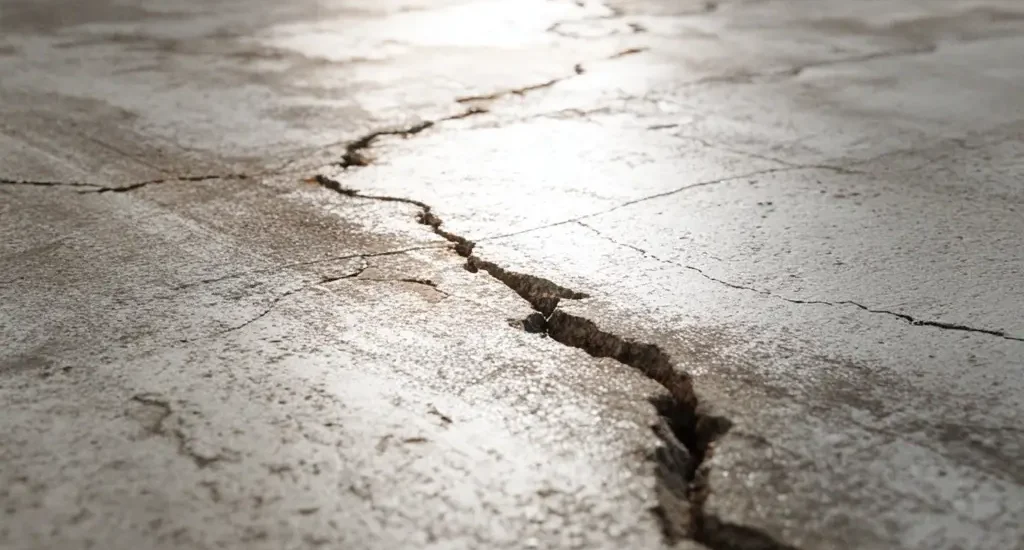
Concrete is usually repair-friendly when the damage is localized.
Small cracks, spalling, chips, worn areas, and some uneven sections can often be corrected without replacing an entire slab.
But repeated cracking deserves more attention.
If movement underneath the slab is causing the problem, filling the crack may improve the surface without solving what caused it.
Concrete repair and surface preparation can also make sense before adding a coating or polished finish.
For larger projects, sealed concrete is one of the lower-cost commercial flooring options, while polished concrete generally costs more because of the grinding and finishing work involved.
Epoxy and commercial coatings
A damaged area of epoxy does not automatically mean the whole floor needs to come out.
Localized coating damage can often be mechanically prepared and recoated.
Widespread peeling, bubbling, or delamination is different.
Before recoating, determine why the original system failed. Moisture, poor surface preparation, contamination, and incompatible coatings can all cause another system to fail in the same place.
Standard commercial epoxy typically falls toward the middle of commercial flooring costs. Heavy-duty chemical-resistant, anti-static, aggregate, or industrial coating systems cost considerably more.
That makes repairing an otherwise sound coating attractive when it can be done correctly.
VCT, LVT, and vinyl
Modular flooring gives you more flexibility.
Individual damaged tiles or planks can often be removed without disturbing an entire floor.
The condition underneath still matters.
If flooring is lifting because moisture or adhesive failure is occurring across the room, replacing isolated pieces may only hide the larger problem temporarily.
LVT replacement commonly falls in the midrange of commercial flooring costs, so repairing a few damaged areas can create a large savings compared with removing a whole floor.
Ceramic and porcelain tile
Tile is another good candidate for localized repair when damage is limited.
A few cracked or loose tiles can often be replaced.
The bigger question is why they cracked.
If the substrate is moving, additional tiles may fail later.
Tile also tends to have a higher replacement cost than VCT or basic commercial vinyl, which makes a proper localized repair worth considering when the rest of the installation is sound.
Do not forget the cost of downtime
For a commercial property, flooring cost is not just labor and material.
Downtime can cost more than the flooring itself.
Think about what happens while the area is unavailable:
- Can employees still work?
- Can customers enter?
- Can forklifts use the aisle?
- Does inventory need to be moved?
- Does a restaurant have to close part of the dining room?
- Can patients still access an office?
- Does a tenant need temporary accommodations?
A repair that costs slightly more but can be completed overnight may be cheaper overall than a lower-priced option that shuts down part of the building for two days.
This is especially important with coatings and adhesives that need cure time before traffic returns.
Ask the contractor for two timelines:
How long will the crew be working?
And:
When can the floor actually go back into service?
Those are not always the same answer.
Can commercial flooring work be phased?
Often, yes.
Phasing can make a larger project much easier on an operating facility.
Instead of shutting down an entire floor, warehouse, store, or office, the project may be divided into sections.
One section is repaired or replaced, returned to service, and then work moves to the next section.
After-hours and weekend work can also reduce disruption.
There is a tradeoff.
Multiple mobilizations and restricted work windows may increase the flooring cost.
But if the alternative is shutting down operations, the additional construction cost may still be cheaper.
The right comparison is project cost plus operational cost, not just the contractor’s invoice.
A simple way to compare repair vs. replacement
Do not compare only the two quotes.
Compare what each option buys you.
For example:
Repair option
Repair cost: $8,000
Expected additional floor life: 3 years
Operational downtime: one night
Replacement option
Replacement cost: $28,000
Expected additional floor life: significantly longer
Operational downtime: three days
Repair looks cheaper immediately.
Now change the situation.
Suppose the floor has already needed $12,000 in repairs over the last two years, several additional areas are beginning to fail, and another large repair is likely next year.
Now the replacement starts to look different.
There is no universal percentage where replacement suddenly becomes the correct answer.
You need to look at the condition of the entire floor and the likelihood of paying for the same problem again.
Five questions to ask before approving the project
1. What caused the damage?
Do not approve another surface repair until you know whether the problem is impact, moisture, movement, adhesion, wear, or something underneath.
2. How much of the floor is actually affected?
Inspect beyond the obvious damaged area.
3. How much useful life is left in the surrounding floor?
There is little value in making an expensive permanent repair inside a floor that is already near replacement.
4. How long will each option take?
Get working time and return-to-service time separately.
5. Have we repaired this floor before?
Pull the maintenance history.
Repeated floor repairs often tell you more than the latest damaged section does.
What about Sacramento vs. the Bay Area?
The decision process is the same, but the economics can change.
Commercial properties in Sacramento, West Sacramento, Roseville, Elk Grove, Folsom, and surrounding markets generally operate in a lower-cost labor environment than San Francisco and much of the core Bay Area.
Bay Area projects can also carry additional logistical costs from building access, parking, loading restrictions, high-rise work, restricted construction hours, and tighter scheduling requirements.
That makes downtime planning particularly important.
If you manage multiple properties, it is worth evaluating each project individually rather than applying the same square-foot budget across every location.
Vertex Maintenance serves commercial properties throughout its Sacramento and Bay Area service areas.
So, should you repair or replace the floor?
If the damage is isolated, the underlying floor is sound, and the cause can be corrected, repair is usually the first option worth pricing.
If failures are spreading, repairs keep coming back, moisture or substrate problems affect multiple areas, or the floor is already near the end of its useful life, replacement deserves a serious comparison.
The cheapest invoice today is not always the cheapest floor over the next five years.
Look at:
- Current repair cost
- Previous repair spending
- Likelihood of another failure
- Remaining life of the floor
- Replacement cost
- Downtime
- Cost of shutting down the affected space
Then make the decision.
If you need someone to inspect the floor before deciding, Vertex Maintenance provides commercial floor repair and replacement for offices, warehouses, retail properties, industrial facilities, healthcare buildings, schools, and other commercial properties.
You can also request a commercial flooring estimate so the damaged area can be evaluated before committing to repair or full replacement.
Commercial floor repair FAQs
How much does commercial floor repair cost per square foot?
There is no reliable single per-square-foot price for commercial floor repair. Small repairs may be driven more by mobilization, demolition, preparation, and minimum labor than square footage. Larger flooring projects can range from a few dollars per square foot for basic concrete treatments to $20 or more per square foot for specialized tile, coatings, or industrial flooring systems.
Is repairing commercial flooring cheaper than replacing it?
Usually, if the damage is localized. Repair becomes less attractive when failures are widespread or the same floor needs repeated work.
When should commercial flooring be replaced instead of repaired?
Consider replacement when damage appears in multiple areas, the floor repeatedly fails, the substrate has widespread problems, matching materials are unavailable, or the existing flooring is near the end of its usable life.
Can a business stay open during commercial floor repair?
Often it can. Localized work may be isolated, phased, or scheduled at night or over a weekend. Cure times, adhesives, coatings, equipment access, and the layout of the building determine when the area can safely return to service.
How much does commercial flooring replacement cost?
The material makes a major difference. Basic sealed concrete can start around a few dollars per square foot, while polished concrete, epoxy, LVT, tile, and specialty industrial systems can range considerably higher. Existing-floor removal, preparation, moisture mitigation, leveling, and restricted work hours can add to the total.
Is commercial flooring more expensive in the Bay Area than Sacramento?
It often can be because labor costs are higher in the Bay Area and some properties have more complicated access and scheduling requirements. The size of the difference depends on the flooring system, building, scope, and schedule, so the actual project should still be quoted individually.